

GLP 1 GOLD RUSH
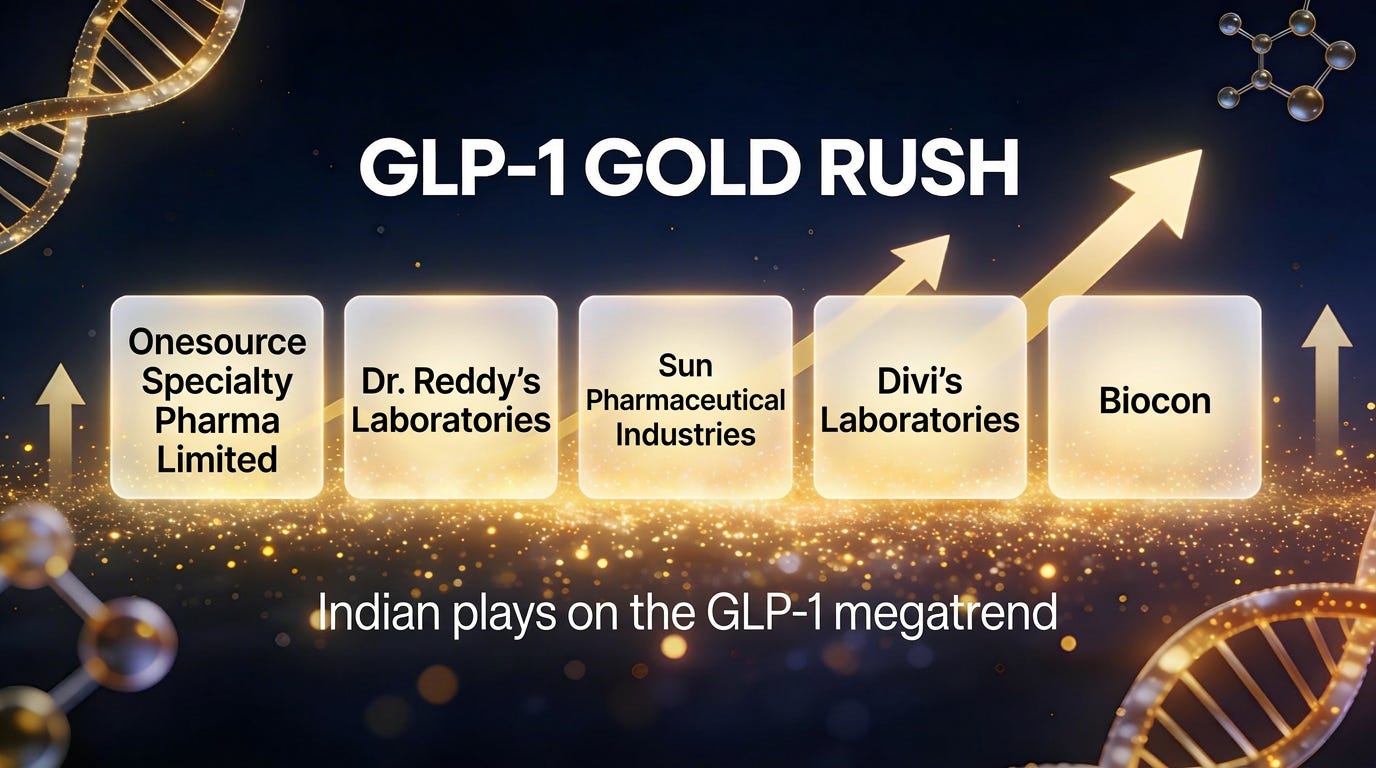
5 Companies that can benefit from Indian GLP-1 Megatrend. Onesource Specialty Pharma Limited, Dr. Reddy’s Laboratories, Sun Pharmaceutical Industries, Divi’s Laboratories, Biocon.

Something historic happened this week. On March 20, 2026, semaglutide’s composition patent expired in India. By March 21, more than half a dozen Indian generic manufacturers had legal clearance to sell their own versions of the world’s most talked-about drug.
This is not a gradual transition. It is a wall of capital, chemistry, and clinical ambition colliding with an unmet medical need of truly staggering proportions — 89 million diabetic adults and a fast-growing obesity crisis in a nation of 1.4 billion people.
The global GLP-1 market sits at roughly $50 billion today. Analysts at UBS see it reaching $126–157 billion by the end of the decade. India’s slice alone is projected to grow at a 34% CAGR through 2030. The companies best positioned to capture this wave span the entire value chain — from API chemistry and CDMO manufacturing through branded generics and novel molecules.
Below, we profile five Indian companies at the centre of the action.
$157BGlobal GLP-1 market by 2030
34%India GLP-1 CAGR ‘25–’30
50+Indian generics in pipeline
Company Profiles
01 of 05
OneSource Specialty Pharma
NSE: ONESOURCE · Sector: CDMO / Injectables
You can read my earlier article:
CDMO
OneSource is the GLP-1 pure-play you cannot ignore. As a dedicated CDMO manufacturing complex injectables, vials, and pen devices, it sits directly in the supply chain of every major GLP-1 generic launch — not as a brand competing for shelf space, but as the factory behind the brands.
▲Strength
Pure-play GLP-1 CDMO; added 15 obesity/diabetes orders in FY25 alone
Exclusive MENA commercialisation deal with Hikma following SFDA approval of generic semaglutide
Manufacturing partner for Dr. Reddy’s semaglutide — direct exposure to generic launch upside
Expertise in pen-device fill-finish, a critical bottleneck for all GLP-1 launches
▼Risk
Revenue fell 26% YoY in Q3 FY26 (₹290 cr) after Health Canada issued a Notice of Non-Compliance to DRL, delaying commercial supply shift
EBITDA collapsed 88% YoY in same quarter — thin margins on a largely fixed cost base
Net debt jumped to ₹903 cr by Sep-25; elevated leverage is a real concern
Promoter pledge at 18.5% — falling but still a governance watchpoint
Delhi High Court patent suit by Novo Nordisk temporarily restraining India marketing
◆Opportunity
CEO confirmed commercial GLP-1 revenues will accelerate as key markets open post-2026 patent expiry across 100+ countries
Pen device demand surge: analysts see 500M–1B additional pens annually as generics scale — a potential $1–2B incremental CDMO opportunity
MENA region (Saudi Arabia ~30% of MEA GLP-1 market) now unlocked via Hikma
Government PLI scheme for pharma could lower production costs
◈Valuation
Trailing PE ~675x (earnings trough-distorted); EV/EBITDA at 36.7x vs 3-yr avg of 84.9x — rare discount on EV basis
Stock down ~19% from Jan-26 highs after Q3 miss; analyst buy target ₹2,475 implies 100%+ upside from Jan-26 lows
Priced as a turnaround; highly sensitive to Canada regulatory resolution
3-Year Earnings Outlook (Consensus Estimates — FY)
FY 2026E₹1,200 crRevenue (recovery path)
FY 2027E₹1,800 crCommercial supply ramp
FY 2028E₹2,800 crMulti-market GLP-1 scale
⚡Bottom line: OneSource is the highest-beta GLP-1 bet in India — enormous upside if Canada clears and commercial revenues ramp, but Q3 FY26 was a sobering reminder of how fragile the near-term picture remains. A high-risk, high-conviction position for investors with a 24–36 month horizon.
02 of 05
Dr. Reddy’s Laboratories
NSE: DRREDDY · Sector: Branded Generics / Global Pharma
Generic Leader
India’s most globally ambitious pharma house, DRL already has regulatory permission in India to market generic semaglutide — arguably making it the first-mover in the most consequential generic launch since the HIV drug era.
▲Strength
Already CDSCO-approved for generic semaglutide — first-mover in India
Extensive global regulatory track record in complex injectables
Strong US presence to pivot once US patents expire post-2030
Backed by OneSource CDMO for manufacturing at scale
▼Risk
Health Canada Notice of Non-Compliance delayed the crucial Canada launch timeline
Novo Nordisk litigation in India poses injunction risk on domestic commercialisation
Price erosion in core US generics business continues to weigh on margins
GLP-1 contribution remains small vs total revenue in the near term
◆Opportunity
Early generic launch by mid-2026 could capture outsized market share before 50+ competitors arrive
India + Canada + emerging markets form a 3-year runway before the big US prize opens
Tirzepatide patent expiry in 2027–28 is the next GLP-1 wave in the pipeline
◈Valuation
Trades at ~26x FY26E earnings — moderate premium for a quality large-cap; broadly fair on core business, GLP-1 optionality is not yet priced in
Analysts identify DRL as a “prime contender” with upside of 20–30% over 18 months if GLP-1 revenues materialise
3-Year Earnings Outlook (Consensus Estimates — FY)
FY 2026E₹30,500 crRevenue (consensus)
FY 2027E₹34,000 crGLP-1 adds ~5–8%
FY 2028E₹39,000 crMulti-market scale
🔬Bottom line: DRL offers the most de-risked GLP-1 entry for conservative investors. Regulatory approval is in hand; global infrastructure is ready. The Canada hiccup is a bump, not a wall. A core quality holding with a meaningful free option on one of history’s biggest drug launches.
03 of 05
Sun Pharmaceutical Industries
NSE: SUNPHARMA · Sector: Specialty / Branded Generics
Novel + Generic
India’s largest pharma company by market cap is playing a longer but higher-reward GLP-1 game. While competitors rush generics, Sun is developing Utreglutide — a proprietary novel GLP-1 molecule now in Phase 2 trials — which could deliver far superior margins than any commodity generic.
▲Strength
Utreglutide in Phase 2 — a proprietary novel GLP-1 molecule, not just a generic copy
Largest Indian pharma by market cap (~₹4.4 trillion); financial firepower to invest in R&D and capacity
Strong execution history in specialty pharma (dermatology, ophthalmology) — transferable capabilities
Positioned as “likely long-term winner” by Choice Broking due to innovation edge
▼Risk
Delayed entry into the generic semaglutide race — early-mover advantage lost to DRL and others
Phase 2 is still 2–3 years from commercialisation; Utreglutide is a long-dated option
US generics pricing headwinds persist across the portfolio
At P/E ~40x, valuation leaves limited room for earnings misses
◆Opportunity
If Utreglutide succeeds, Sun becomes the only Indian pharma with a branded innovative GLP-1 — margins of 70%+ vs 15–25% for generics
Zydus licensing partnership gives Sun a generic semaglutide on-ramp via Lupin collaboration network
Branded specialty model well-suited for obesity as a premium, physician-prescribed category
◈Valuation
Trades at ~40x FY26E earnings — premium for quality and innovation pipeline is justified, but already partly priced in
Utreglutide success could re-rate the stock meaningfully; failure would see the stock revert to 30x on core business alone
3-Year Earnings Outlook (Consensus Estimates — FY)
FY 2026E₹52,000 crRevenue
FY 2027E₹59,000 crSpecialty+GLP-1 ramp
FY 2028E₹68,000 crUtreglutide optionality
🏆Bottom line: Sun Pharma is the blue-chip GLP-1 play. Not the fastest out of the gate, but the one most likely to be standing tall in 2030 with a differentiated product. The Utreglutide option alone makes a compelling case for long-term allocation — if it succeeds, this stock re-rates dramatically.
04 of 05
Divi’s Laboratories
NSE: DIVISLAB · Sector: API / Custom Synthesis
API Supplier
Divi’s is the quiet, high-margin pick-and-shovel play on the GLP-1 boom. While generics companies compete fiercely on price and brands, Divi’s supplies the raw peptide ingredients and custom synthesis services that every GLP-1 manufacturer needs — regardless of who wins the commercial race.
▲Strength
Large-scale custom synthesis capabilities for peptide APIs — a core GLP-1 ingredient supplier
Confidential CDMO contracts (signed under CDA) suggest active semaglutide development
Projected to generate ~$450M in peptide revenue by 2030 per industry estimates
Margin-accretive opportunity — management has confirmed GLP-1 peptide work is gross margin positive
▼Risk
No public disclosure of GLP-1 client names or revenue quantum — opaque near-term visibility
Biosynthetic peptide production is technically complex; few Indian firms can do it at scale
Margin pressure if protected amino acids and coupling reagents become supply-constrained
US regulatory risk (USFDA inspections) is always a background concern
◆Opportunity
Positioned as a “key API supplier” to benefit indirectly from every GLP-1 generic launch in India and globally
India’s peptide CDMO segment ($80M today) is projected to grow at 14% CAGR over five years
Anthem Biosciences reports a surge in peptide API inquiries — Divi’s likely seeing the same demand wave
◈Valuation
Trades at ~45x FY26E earnings — premium to large-cap pharma peers, reflecting the GLP-1 optionality the market is already crediting
Historically a high-quality compounder; investors pay up for capital efficiency and margin profile
3-Year Earnings Outlook (Consensus Estimates — FY)
FY 2026E₹9,500 crRevenue
FY 2027E₹11,200 crGLP-1 API visibility
FY 2028E₹14,000 crPeptide ramp + CDMO
⚗️Bottom line: For investors who want GLP-1 exposure without the binary risks of a single generic launch, Divi’s is the answer. You win regardless of which brand dominates the consumer market. The opacity around its pipeline is its main weakness — but history suggests Divi’s management under-promises and over-delivers.
05 of 05
Biocon
NSE: BIOCON · Sector: Biologics / Biosimilars
Biologics
India’s premier biologics company, Biocon brings something rare to the GLP-1 table: proven biosimilar manufacturing at global scale. GLP-1 agonists like semaglutide are peptide-based biologics — far more complex than chemical generics — and Biocon’s 30-year pedigree in biologics is directly applicable.
▲Strength
Regulatory filings for GLP-1 candidates already submitted in multiple markets including India
Glenmark launched a generic liraglutide in 2024 (Biocon tech-transfer heritage) — proof of execution
Biologics infrastructure (Biocon Biologics) is directly suited to peptide-based GLP-1 manufacturing
Global partnerships and presence in regulated markets (US, EU, emerging)
▼Risk
Biocon Biologics IPO and leverage elevated the group’s debt profile significantly
Competitive pressure on existing biosimilars (insulin, trastuzumab) compresses overall margins
Complex regulatory landscape for biologics is more demanding than small-molecule generics
GLP-1 filing timelines have not been publicly confirmed — execution risk remains
◆Opportunity
India’s CDSCO fast-tracking GLP-1 approvals — regulatory tailwind for a company already in the system
Massive unmet demand in the Indian market; Biocon’s affordable biosimilar model is built precisely for this
Government PLI scheme and planned pharma incentives for obesity drugs create favourable cost environment
◈Valuation
Listed Biocon trades at a discount to pure-play biosimilar peers globally due to the complex holding structure
GLP-1 success could be a significant re-rating catalyst; the stock is arguably not pricing in GLP-1 optionality at current levels
Execution on debt reduction from Biocon Biologics is the key near-term watchpoint
3-Year Earnings Outlook (Consensus Estimates — FY)
FY 2026E₹16,500 crGroup Revenue
FY 2027E₹19,500 crBiosimilar + GLP-1
FY 2028E₹23,000 crGLP-1 scale + debt reduction
🧬Bottom line: Biocon is the under-appreciated GLP-1 story. The market is so focused on chemical generics that it is overlooking the company best equipped to manufacture the biologics-grade semaglutide that the most demanding regulated markets will require. If management delivers on the biologics roadmap and reduces leverage, the re-rating could be significant.
The Big Picture
One drug. Five stories. One thesis.
The patent cliff on semaglutide is not a single event — it is a multi-year reshaping of global pharmaceutical supply chains, and India sits at the heart of it. With cost-competitive manufacturing, a rapidly growing domestic patient population, and a government actively incentivising GLP-1 production, the conditions are uniquely favourable.
The five companies profiled here represent different risk/reward profiles along the value chain. OneSource is the high-risk, highest-beta CDMO play. Dr. Reddy’s is the near-term first-mover. Sun Pharma is the long-game innovator. Divi’s is the low-drama, high-quality pick-and-shovel. And Biocon is the under-the-radar biologics specialist that the market may be sleeping on.
Analysts expect only 6–8 brands to survive long-term out of 50+ generic entrants. The winners will be those who master complex manufacturing, maintain cold chain integrity, and differentiate through quality or delivery innovation. The companies above are among the best positioned to do exactly that.
The GLP-1 gold rush has officially begun. The question is not whether Indian pharma benefits — it is which companies emerge as the lasting winners.
Disclaimer: This article is for informational and educational purposes only and does not constitute investment advice, a solicitation, or a recommendation to buy or sell any securities. Revenue and earnings figures marked “E” are analyst consensus estimates or author projections based on publicly available information and may differ materially from actual results. Past performance is not indicative of future results. Always conduct your own due diligence or consult a SEBI-registered investment advisor before making investment decisions. The author may or may not hold positions in securities mentioned.